Introduction
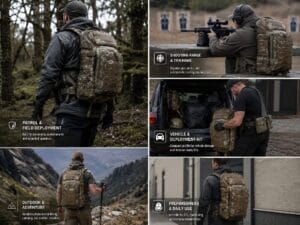
Many military and law enforcement procurement teams use the terms “patrol pack” and “assault pack” interchangeably. However, these backpack types are designed for different mission requirements.
While both support tactical operations, they differ significantly in carrying capacity, mission duration, equipment load, and mobility.
Understanding these differences can help organizations improve equipment standardization, reduce unnecessary weight, and select the most suitable backpack for operational requirements.
In this guide, we compare patrol packs and assault packs from a mission-focused perspective to help procurement teams and end users make informed decisions.
Related Guide:
Military Backpack Capacity Guide
What Size Tactical Backpack Do I Need
Why The Difference Matters
A patrol pack and an assault pack may appear similar at first glance, yet selecting the wrong type can significantly affect mission performance. Choosing a backpack that is too small may limit its capacity for carrying equipment, while selecting a larger pack than necessary can reduce mobility and increase fatigue. Understanding the intended mission profile is therefore more important than comparing capacity numbers alone.
Quick Answer
Choose A Patrol Pack If:
- Missions typically last less than 24 hours
- Mobility and rapid movement are priorities
- Personnel carry only essential equipment
- Daily patrol and law enforcement operations are common
Choose An Assault Pack If:
- Missions exceed 24 hours
- Additional sustainment equipment is required
- Field deployment is expected
- Equipment loads vary significantly
In simple terms:
Patrol Packs prioritize mobility. Assault Packs prioritize carrying capacity and sustainment capability.
What Is A Patrol Pack
Think of a patrol pack as a mobility-focused backpack.
It is designed for operators who need to carry essential equipment while maintaining speed, agility, and rapid access to gear throughout a shift or patrol cycle.
For most users, a patrol pack functions as a daily-duty backpack rather than a sustainment pack.
A patrol pack is designed for short-duration missions where mobility and rapid access to equipment are the primary priorities.
These backpacks are commonly used by patrol units, law enforcement personnel, and security teams conducting daily operations.
Related Guide:
Typical Patrol Pack Specifications
| Feature | Patrol Pack |
| Capacity | 20L-35L |
| Mission Duration | 8-24 Hours |
| Weight | Light |
| User | Patrol Units |
| Loadout | Essential Gear |
Typical Applications:
- Urban Patrol
- Border Patrol
- Law Enforcement Operations
- Security Operations
- Rapid Response Missions
Typical Equipment:
- Hydration System
- Radio
- Medical Kit
- Ammunition
- Batteries
- Personal Equipment
Internal Link:
What Is An Assault Pack
An assault pack bridges the gap between a patrol backpack and a full-size military rucksack.
It is intended for missions in which personnel must remain operational for extended periods without immediate resupply while maintaining reasonable mobility.
An assault pack is designed for longer missions that require additional equipment and sustainment capability.
These backpacks are commonly used by military assault teams, special operations units, and personnel conducting multi-day operations.
Typical Assault Pack Specifications
| Feature | Assault Pack |
| Capacity | 30L-50L |
| Mission Duration | 24-72 Hours |
| Weight | Medium |
| User | Assault Teams |
| Loadout | Extended Equipment |
Typical Applications:
- Military Training
- Extended Patrol Missions
- 72 Hour Operations
- Field Deployment
- Multi-Day Missions
Typical Equipment:
- Additional Ammunition
- Food Supplies
- Extra Water
- Shelter Equipment
- Additional Clothing
- Mission Sustainment Gear
Related Guides
- 20L vs 30L vs 45L Tactical Backpack
- Best Military Backpack Capacity For Different Operations
- How To Choose Backpack Capacity
Patrol Pack vs Assault Pack: Key Differences
| Comparison Criteria | Patrol Pack | Assault Pack |
| Typical Capacity | 20L–35L | 30L–50L |
| Mission Duration | 8–24 Hours | 24–72 Hours |
| Primary Purpose | Daily Patrol Operations | Extended Tactical Operations |
| Equipment Load | Essential Gear | Extended Equipment & Sustainment Gear |
| Mobility | High | Medium |
| Expansion Capability | Limited | High |
| Sustainment Capability | Limited | High |
| Typical User | Patrol Personnel | Assault Teams |
| Typical Missions | Urban Patrol, Border Patrol, Law Enforcement Operations | Military Training, Field Deployment, Multi-Day Missions |
| Best Use Case | Daily Operations | Extended Missions |
The primary difference between a patrol pack and an assault pack is the balance between mobility and carrying capacity.
Patrol packs are optimized for daily operations where speed and agility are critical, while assault packs are designed for missions that require additional equipment and sustainment capabilities.
Need Help Comparing Capacity Requirements?
Why Many Teams Choose The Wrong Backpack
One of the most common mistakes is assuming that larger backpacks automatically improve mission capability.
In reality, patrol personnel often carry oversized backpacks that are rarely used, while some field teams struggle with insufficient capacity because their backpacks were selected primarily for mobility.
The right choice depends on mission requirements rather than maximum storage volume.
Procurement Resource
Military Backpack Capacity Requirements For Government Procurement
Can An Assault Pack Replace A Patrol Pack?
In some situations, an assault pack can be used for patrol operations. However, larger backpacks often increase fatigue and reduce mobility during routine patrol missions.
For units primarily conducting daily patrol operations, a dedicated patrol pack usually provides the best balance between mobility and equipment capacity.
For organizations that require a single backpack platform to support multiple mission profiles, an assault pack may offer greater flexibility.
Related Guide: 24-Hour Pack vs 72 Hour Pack
Can A Patrol Pack Replace An Assault Pack?
In most cases, a patrol pack is not an ideal replacement for an assault pack during extended operations.
While patrol packs offer excellent mobility, they often lack the capacity required for food supplies, additional water, sleeping systems, and other sustainment equipment.
For missions lasting more than 24 hours, an assault pack generally provides a more practical solution.
What is the most versatile type of tactical backpack?
If an organization can only select one backpack platform, an assault pack is often considered the most versatile option.
Compared with patrol packs, assault packs provide greater carrying capacity while still maintaining reasonable mobility.
However, for organizations primarily conducting daily patrols, dedicated patrol packs usually offer greater efficiency and comfort.
Further Reading
Which Backpack Is Better For Different Missions
Patrol Missions
Patrol packs are generally the better choice for urban patrol, border patrol, and law enforcement operations. These missions often prioritize mobility, quick reaction capability, and frequent vehicle access, reducing the need for large-capacity backpacks.
Military Training
Military training activities may require either a patrol pack or an assault pack, depending on mission duration and equipment requirements. Short-duration exercises typically favor patrol packs, while extended field exercises often require assault packs.
Field Deployment
Deployment missions typically require personnel to carry additional food, water, clothing, and sustainment equipment. For this reason, assault packs usually provide a more practical balance between carrying capacity and operational flexibility.
Multi-Day Missions
For missions lasting more than 24 hours, assault packs usually provide the carrying capacity required to support extended operations.
How To Choose Between A Patrol Pack And An Assault Pack
Choose a Patrol Pack If:
- Daily patrol missions
- Fast movement is required
- Equipment load is limited
- Mobility is the primary objective
Choose an Assault Pack If:
- Multi-day missions
- Larger equipment loadouts
- Extended deployment requirements
- Additional sustainment equipment
Procurement Considerations:
For military backpack procurement projects, selecting a combination of patrol packs and assault packs often provides the most effective solution. Rather than issuing a single backpack model to every unit, organizations should align backpack selection with operational roles. Patrol personnel typically benefit from lighter, more mobile patrol packs, while deployment and assault teams often require larger backpacks to carry sustainment equipment. A tiered backpack strategy can improve mission effectiveness while maintaining equipment standardization across the organization.
Further Reading For Procurement Teams
- Military Backpack Capacity Requirements For Government Procurement
- Military Backpack Specifications Explained
- How To Compare Tactical Backpack Suppliers
Recommended Reading
Recommended Tactical Backpack Categories
Different mission profiles require different backpack platforms. Selecting the right category is just as important as choosing the correct capacity.
Patrol Backpack Collection
Designed for urban patrol, border patrol, and law enforcement operations where mobility is the primary objective.
Internal Link → Tactical Assault Packs
Assault Backpack Collection
Suitable for military training, 72-hour operations, field deployment, and missions requiring additional sustainment equipment.
Internal Link → Military Rucksacks
Need a Custom Backpack Configuration?
For procurement projects, organizations often require mission-specific backpack configurations tailored to operational requirements.