Introduction
Choosing the right tactical backpack capacity can significantly impact mobility, load management, and mission effectiveness.
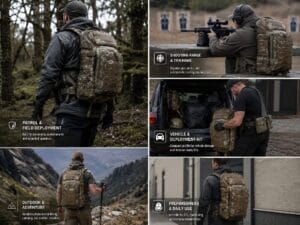
Among the most common backpack sizes used by military personnel, law enforcement teams, and security professionals are 20L, 30L, and 45L tactical backpacks.
Each capacity is designed for different mission durations, equipment loads, and operational requirements.
This guide compares 20L, 30L, and 45L tactical backpacks to help determine which size best fits your mission profile.
Part Of Our Military Backpack Capacity Guide Series
• Military Backpack Capacity Guide
• What Size Tactical Backpack Do I Need
Why Capacity Selection Matters
Many users focus on backpack capacity numbers without fully understanding how capacity affects mission performance.
A 20L backpack may feel too restrictive during a training exercise, while a 45L backpack can become unnecessarily bulky during routine patrol operations.
The goal is not to choose the largest backpack available, but to select a capacity that matches mission requirements, equipment load, and operational objectives.
When Is A 20L Backpack The Better Choice?
A 20L tactical backpack is not designed to carry the most equipment.
It is designed to maximize mobility.
For patrol personnel, law enforcement officers, and rapid response teams, speed often matters more than carrying capacity.
This is where a 20L backpack provides a clear advantage over larger platforms.
Choose 20L When
- Mission duration is under 12 hours
- Mobility is the priority
- Equipment load is limited
- Vehicle support is available
Avoid 20L When
- Multi-day missions are expected
- Additional sustainment equipment is required
- Personnel must remain self-sufficient
Recommended For
Personnel operating on missions shorter than 12 hours, where mobility is the primary objective.
Related Guide: What Size Tactical Backpack Do I Need
Why 30L Is Often The Most Versatile Tactical Backpack Size
If only one backpack size could be selected for general-purpose military and law enforcement use, 30L would be the most common recommendation.
For many military units and law enforcement teams, 30L sits in the middle ground between mobility and carrying capacity.
It provides significantly more storage space than a 20L platform while remaining lighter and easier to maneuver than a 45L backpack.
A 30L tactical backpack is typically large enough to accommodate communications equipment, hydration systems, medical supplies, extra clothing, and mission-specific gear without becoming overly bulky.
This balance makes it suitable for patrol missions, military training, law enforcement operations, and daily tactical activities.
For users who require a single backpack platform that supports multiple mission profiles, 30L is often considered the most versatile choice.
Best For
- Tactical Operations
- Law Enforcement Missions
- Military Training
- Daily Field Operations
- Security Teams
Typical Equipment
- Communications Equipment
- Medical Supplies
- Hydration System
- Extra Clothing
- Mission-Specific Tools
Advantages
- Balanced Capacity
- Versatile Mission Profile
- Suitable For Most Daily Operations
- Better Equipment Organization
Why Many Users Upgrade From 20L To 30L
Compared with a 20L tactical backpack, a 30L platform offers significantly more storage space for communications equipment, extra clothing, and mission-specific gear while maintaining high mobility.
For users who regularly transition between patrol missions, training exercises, and tactical operations, the additional capacity often justifies the slight increase in size and weight.
Why Many Users Choose 30L Instead Of 45L
While a 45L backpack offers greater carrying capacity, many users do not require the additional space on a daily basis.
A 30L tactical backpack is easier to maneuver, lighter to carry, and better suited to routine patrol and law enforcement operations.
For this reason, 30L is often considered the best compromise between mobility and carrying capacity.
Limitations
- Limited Sustainment Capability
- May Be Insufficient For Extended Deployments
Recommended For
Users who need a single backpack that handles most tactical operations and training activities.
Real-World Example
Consider two personnel assigned to different missions.
A patrol officer working an 8-hour shift with vehicle support may only require hydration, communications equipment, and basic medical supplies.
A training instructor spending an entire day in the field may need additional clothing, batteries, documentation, and mission-specific equipment.
Although both personnel require tactical backpacks, their capacity requirements can differ significantly.
Need A More Detailed Selection Framework?
• How To Choose Backpack Capacity
20L vs 30L Tactical Backpack
A 20L tactical backpack prioritizes mobility and rapid movement, while a 30L tactical backpack offers greater flexibility for carrying additional equipment.
Choose a 20L backpack when speed, agility, and short mission duration are the primary priorities.
Choose a 30L backpack when missions require additional clothing, communications equipment, medical supplies, or mission-specific gear.
For most military training and law enforcement operations, a 30L tactical backpack provides a better balance between carrying capacity and mobility.
Further Reading
When Upgrading To A 45L Backpack Makes Sense
Many users assume a larger backpack automatically provides more flexibility.
However, moving from 30L to 45L should usually be driven by mission requirements rather than personal preference.
Once personnel begin carrying food supplies, sleeping systems, and sustainment equipment, the additional capacity becomes necessary.
Best For
- Multi-Day Missions
- Field Deployment
- Extended Training Exercises
- Remote Operations
- Tactical Sustainment Tasks
Typical Equipment
- 72-Hour Loadout
- Food Supplies
- Additional Water
- Sleeping Equipment
- Extra Clothing
- Mission Sustainment Gear
Advantages
- High Carrying Capacity
- Supports Extended Missions
- Greater Equipment Flexibility
- Suitable For Deployment Scenarios
Limitations
- Increased Weight
- Reduced Mobility
- Larger Physical Footprint
Recommended For
Personnel operating in environments where mission duration exceeds 24 hours and additional sustainment equipment is required.
30L vs 45L Tactical Backpack
The decision between a 30L and 45L tactical backpack is usually determined by mission duration and sustainment requirements.
A 30L backpack is typically sufficient for patrol missions, law enforcement operations, and military training activities.
A 45L backpack becomes the better option when personnel must carry food supplies, sleeping systems, additional clothing, and other sustainment equipment for missions lasting more than 24 hours.
If mobility is the priority, choose 30L.
If self-sufficiency and deployment readiness are the priority, choose 45L.
Related Procurement Resource: Military Backpack Capacity Requirements For Government Procurement
Typical Equipment Load Comparison
The easiest way to understand backpack capacity is to compare how much equipment each size can typically carry.
| Capacity | Typical Equipment |
| 20L | Hydration System, Radio, Medical Kit, Batteries |
| 30L | Hydration System, Medical Supplies, Communications Equipment, Extra Clothing |
| 45L | 72-Hour Loadout, Food Supplies, Sleeping Equipment, Additional Water |
Tactical Backpack Capacity Comparison Table
| Criteria | 20L Backpack | 30L Backpack | 45L Backpack |
|---|---|---|---|
| Typical Mission Duration | Up To 12 Hours | 8–24 Hours | 24–72 Hours |
| Patrol Missions | ⭐⭐⭐⭐⭐ | ⭐⭐⭐⭐ | ⭐⭐ |
| Law Enforcement Operations | ⭐⭐⭐⭐ | ⭐⭐⭐⭐⭐ | ⭐⭐⭐ |
| Military Training | ⭐⭐ | ⭐⭐⭐⭐⭐ | ⭐⭐⭐⭐ |
| Field Deployment | ❌ Not Recommended | ⚠️ Limited Suitability | ⭐⭐⭐⭐⭐ |
| Mobility | High | Medium-High | Medium |
| Equipment Capacity | Low | Medium | High |
| Sustainment Capability | Low | Medium | High |
| Daily Use | Excellent | Excellent | Limited |
| Vehicle Operations | Excellent | Good | Moderate |
For most military and law enforcement users, the choice usually comes down to mobility versus carrying capacity.
The more equipment and sustainment gear a mission requires, the larger the backpack capacity should be.
Quick Recommendation
Choose 20L if mobility is your highest priority.
Choose 30L if you need the most versatile all-around tactical backpack.
Choose 45L if your missions regularly exceed 24 hours and require sustainment equipment.
Need Help Comparing Capacity Requirements?
• How To Choose Backpack Capacity
Procurement Considerations For Tactical Backpack Projects
Many procurement teams face the challenge of selecting backpack capacities that support multiple operational roles.
While issuing a single backpack size can simplify purchasing and inventory management, it often creates compromises for end users.
For this reason, many organizations standardize around 30L backpacks for general operations while maintaining larger 45L platforms for deployment and sustainment missions.
Further Reading For Procurement Teams
• Military Backpack Capacity Requirements For Government Procurement
• Military Backpack Specifications Explained
• How To Compare Tactical Backpack Suppliers
Which Tactical Backpack Size Should You Choose?
For military procurement projects,
working with an experienced tactical backpack manufacturer
can help organizations select the most appropriate backpack capacity
for different operational requirements.
Choose A 20L Tactical Backpack If
- Speed and mobility are your priorities
- Missions are typically under 12 hours
- Equipment requirements are minimal
- Hydration and basic gear are sufficient
Choose A 30L Tactical Backpack If
- You need an all-around tactical backpack
- Mission profiles vary frequently
- Additional equipment storage is required
- Law enforcement or training operations are common
Choose A 45L Tactical Backpack If
- Missions exceed 24 hours
- Sustainment equipment is required
- Deployment readiness is important
- Additional clothing, food, and water must be carried
Frequently Asked Questions
Is A 20L Tactical Backpack Too Small?
Not for short patrol missions, range training, and rapid response operations. Many users prefer 20L backpacks because of their mobility advantages.
Is 30 L the Best Tactical Backpack Size?
For many military and law enforcement applications, 30L offers the best balance between mobility and carrying capacity.
Is a 45L Backpack Suitable For Daily Use?
A 45L backpack can be used daily, but it may be larger than necessary for routine patrol or training activities.
Is a 30L Tactical Backpack Better Than A 20L Backpack?
Not necessarily.
A 30L backpack offers greater carrying capacity, but a 20L backpack may provide better mobility for patrol and rapid response operations.
The better choice depends on mission requirements rather than capacity alone.
What is the best size for a tactical backpack for military training?
For most military training activities, a 30L tactical backpack provides the best balance between carrying capacity and mobility.
However, extended field exercises may require a 45L backpack to accommodate additional clothing, food supplies, and sustainment equipment.
Which Capacity Matches Your Mission?
- Patrol & Rapid Response Operations: Explore 20L Tactical Backpacks
- Daily Operations & Military Training: Explore 30L Tactical Backpacks
- Field Deployment & Extended Missions: Explore 45L Tactical Backpacks
Need Help Selecting The Right Capacity?
Whether you are sourcing equipment for military units, law enforcement teams, or procurement projects, our team can recommend the most suitable backpack capacity based on mission requirements and operational objectives.