Introduction
Selecting the right military backpack capacity is one of the most important decisions for mission planning, equipment management, and procurement projects.
A backpack that is too small may not provide enough space for essential gear, while an oversized backpack can reduce mobility, increase fatigue, and negatively impact operational performance.
For military units, law enforcement agencies, and tactical procurement teams, choosing the correct backpack size requires balancing mission duration, equipment load, and operational requirements.
This military backpack capacity guide explains how different backpack sizes are used, how much equipment they can carry, and how to select the most suitable capacity for patrol missions, training exercises, and multi-day deployments.
Part Of Our Military Backpack Capacity Guide Series
Military Backpack Capacity Guide
What Size Tactical Backpack Do I Need
Quick Capacity Recommendation
If you only remember one thing from this guide, remember this:
- 20L–30L backpacks are generally best for patrol and law enforcement operations where mobility is the priority.
- 30L–45L backpacks offer the most balanced solution for military training, assault operations, and general-purpose tactical use.
- 45L–65L backpacks are designed for field deployment and multi-day missions that require additional equipment, food, and sustainment supplies.
- 65L+ military rucksacks are intended for extended operations where personnel must remain self-sufficient for several days.
| Mission Type | Capacity |
| Hydration & Short Patrol | 10L-20L |
| Daily Patrol | 20L-30L |
| Military Training | 30L-45L |
| Field Deployment | 45L-65L |
| Extended Operations | 65L+ |
For most military and law enforcement applications, 30L–45L remains the most versatile backpack capacity range.
What Is The Most Versatile Military Backpack Size?
If only one backpack capacity could be selected for a wide range of military and law enforcement applications, 30L–45L would generally provide the best balance between mobility and carrying capacity.
This capacity range supports patrol missions, training exercises, law enforcement operations, and short-term deployment tasks while remaining manageable for daily use.
For this reason, many procurement teams standardize around the 30L–45L range for general-purpose tactical backpack programs.
Why Backpack Capacity Is More Important Than Most Buyers Think
Many buyers focus on materials, MOLLE systems, and storage compartments when comparing military backpacks.
However, capacity often has a greater impact on mission performance than any other feature.
Choosing the wrong backpack size can affect mobility, load distribution, endurance, and equipment accessibility.
Before comparing fabrics or accessories, organizations should first determine how much equipment personnel need to carry and how long they will operate without resupply.
Too Small
A backpack that is too small may force personnel to leave essential equipment behind or attach gear externally, reducing accessibility and operational efficiency.
Too Large
An oversized backpack often encourages unnecessary loading, increases fatigue, and reduces mobility during patrol and response missions.
Poor Standardization
Using a single backpack size for all personnel can lead to equipment mismatches and increase procurement costs.
Military Backpack Capacity Chart
One of the most common questions buyers ask is how backpack capacity relates to mission duration.
The following military backpack capacity chart provides a general guideline.
| Capacity | Mission Duration | Typical Use |
| 10L-20L | 4-12 Hours | Hydration & Short Patrol |
| 20L-30L | 8-24 Hours | Patrol Missions |
| 30L-45L | 24-48 Hours | Assault Operations |
| 45L-65L | 48-72 Hours | Field Deployment |
| 65L+ | 72+ Hours | Extended Deployment |
While actual requirements vary depending on equipment load, climate, and mission profile, these capacity ranges are commonly used across military and law enforcement operations.
Not sure which capacity is right for your mission? Read:
• What Size Tactical Backpack Do I Need
• 20L vs 30L vs 45L Tactical Backpack
• 24 Hour Pack vs 72 Hour Pack
• How To Choose Backpack Capacity
What Size Military Backpack Do I Need?
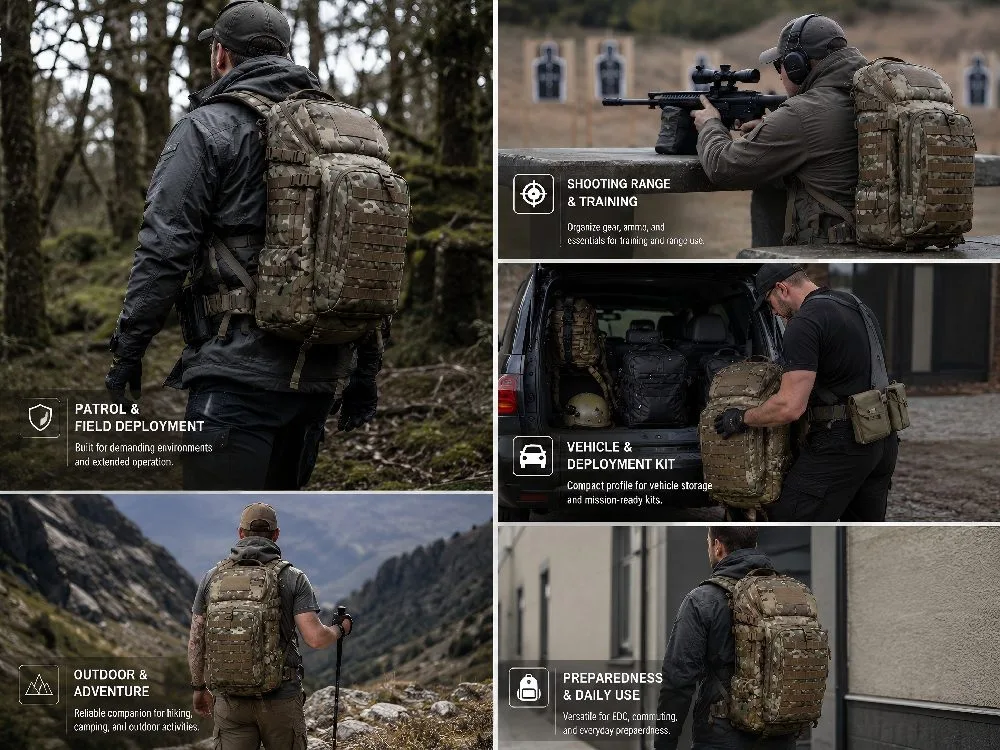
For Patrol Missions
Most patrol units prioritize mobility over carrying capacity.
Personnel typically carry hydration systems, communications equipment, medical supplies, and basic mission gear.
For these requirements, a 20L–30L tactical backpack is usually sufficient.
For Law Enforcement Operations
Law enforcement personnel often require additional communications equipment, medical supplies, and tactical gear while maintaining rapid mobility.
For Military Training
Training exercises often require additional clothing, protective equipment, and sustainment supplies.
As a result, most military training activities are better supported by backpacks in the 30L–45L range.
For Field Deployment
Field deployment missions often extend beyond a single day and require food supplies, sleeping equipment, and additional mission support gear.
For Extended Operations
Long-duration deployments require personnel to remain self-sufficient while carrying larger quantities of equipment and sustainment supplies.
For Procurement Projects
For procurement teams, selecting a combination of backpack capacities often provides greater flexibility than standardizing on a single size. Patrol units, training personnel, and deployment teams typically require different carrying capacities to support their operational roles.
Recommended Approach:
• 20L–30L For Patrol Units
• 30L–45L For Training Personnel
• 45L–65L For Deployment Teams
Need a more detailed sizing guide? Read:
• How To Choose Backpack Capacity
• Backpack Volume Explained
• Military Rucksack Size Guide
How Much Gear Can Different Backpack Sizes Carry
One of the biggest challenges when selecting a military backpack is visualizing how much equipment different capacities can actually hold.
While backpack capacity is measured in liters, most buyers think in terms of mission equipment rather than volume.
The examples below show how different backpack sizes are commonly used in military and law enforcement operations.
20L Tactical Backpack
A 20L backpack is designed for short-duration missions where mobility is more important than carrying capacity.
Typical Loadout
- 2L Hydration System
- Radio
- Medical Kit
- Ammunition
- Batteries
- Small Personal Equipment
Typical Missions
- Urban Patrol
- Law Enforcement Operations
- Range Training
Internal Link: What Can Fit Inside A 20L Tactical Backpack
30L Tactical Backpack
A 30L backpack is often considered the most versatile size for daily tactical operations.
Typical Loadout
- Hydration System
- Communications Equipment
- Medical Supplies
- Extra Clothing
- Mission-Specific Equipment
Typical Missions
- Daily Patrol
- Military Training
- Tactical Response Operations
45L Military Backpack
A 45L backpack supports extended missions that require additional equipment and sustainment gear.
Typical Loadout
- 72-Hour Loadout
- Food Supplies
- Sleeping System
- Spare Clothing
- Medical Equipment
- Communications Equipment
Typical Missions
- Military Training
- Field Deployment
- 72 Hour Operations
Internal Link: What Can Fit Inside A 45L Military Backpack
65L Military Rucksack
A 65L military rucksack is designed for deployment and sustainment missions.
Typical Loadout
- Multi-Day Equipment
- Food Supplies
- Sleeping Equipment
- Shelter System
- Additional Clothing
- Extra Ammunition
- Mission Sustainment Gear
Typical Missions
- Extended Deployment
- Remote Operations
- Multi-Day Field Missions
Internal Link: How Much Gear Can A 65L Military Backpack Carry
Capacity Comparison Summary
Different backpack capacities serve different operational purposes.
| Capacity | Best For | Mission Duration |
| 20L | Short Patrol Missions | 4–12 Hours |
| 30L | Daily Tactical Operations | 8–24 Hours |
| 45L | Military Training & Assault Operations | 24–72 Hours |
| 65L+ | Deployment & Extended Operations | 72+ Hours |
For most military and law enforcement users, the decision is not about choosing the largest backpack. It is about selecting the capacity that best matches mission duration and equipment requirements.
20L vs 30L Tactical Backpack
A 20L backpack prioritizes mobility and rapid movement, while a 30L backpack offers greater flexibility for carrying mission-essential equipment.
Read More:20L vs 30L Tactical Backpack: Which Size Is Better
30L vs 45L Tactical Backpack
A 45L backpack provides significantly more storage capacity for extended operations but may reduce mobility compared with a 30L platform.
Read More:30L vs 45L Military Backpack Comparison
45L vs 65L Military Backpack
A 65L military rucksack is intended for deployment scenarios where sustainment equipment is critical.
Internal Link Opportunity
- 20L Tactical Backpack Guide
- 30L Tactical Backpack Guide
- 45L Military Backpack Guide
Common Capacity Selection Mistakes
Choosing Oversized Backpacks
Larger is not always better. Oversized backpacks often encourage unnecessary equipment loading and increase fatigue.
Ignoring Mission Duration
Mission duration should be one of the primary factors when selecting a backpack.
Underestimating Equipment Requirements
Many organizations fail to account for radios, batteries, medical equipment, and mission-specific gear when estimating capacity needs.
Failing To Plan Future Expansion
Equipment requirements often evolve over time. Procurement teams should consider future operational needs when selecting backpack systems.
Many capacity selection mistakes occur because procurement teams fail to accurately estimate equipment volume.
Read More: How Military Backpack Capacity Is Tested And Verified
Military Backpack Capacity For Procurement Projects
For procurement teams, backpack capacity selection involves more than simply choosing the largest available model. The right capacity plan should support operational requirements, equipment compatibility, inventory management, and future mission needs.
Unit Standardization
Standardized backpack capacities simplify logistics, training, and inventory management. However, relying on a single backpack size for all personnel may create equipment mismatches across different mission profiles.
Mission Requirements
Different units often require different capacity ranges depending on operational roles, mission duration, and deployment environments. Patrol-focused units typically prioritize mobility, while deployment-focused units require greater carrying capacity for sustainment equipment.
Equipment Compatibility
Backpacks should be compatible with body armor systems, hydration systems, communication equipment, medical kits, and modular pouches. Capacity should always be evaluated alongside load distribution and equipment accessibility.
Future Scalability
Procurement decisions should account for future upgrades, mission changes, and equipment expansion requirements. Selecting a scalable backpack platform can reduce replacement costs and improve long-term operational flexibility.
Recommended Capacity Mix For Procurement Projects
Many organizations achieve better operational efficiency by procuring a combination of backpack capacities rather than standardizing on a single size.
Law Enforcement Agencies
Recommended Mix:
- 70% 30L Tactical Backpacks
- 30% 45L Tactical Backpacks
This combination supports daily patrol duties, tactical response operations, and specialized law enforcement missions.
Military Training Units
Recommended Mix:
- 60% 30L–45L Tactical Backpacks
- 40% 45L Military Backpacks
This approach provides flexibility for classroom training, field exercises, and general-purpose military activities.
Field Deployment Units
Recommended Mix:
- 40% 45L Military Backpacks
- 60% 65L Military Rucksacks
Larger-capacity backpacks are better suited for multi-day deployments, remote operations, and missions requiring additional sustainment equipment.
The ideal capacity mix depends on mission duration, equipment requirements, and operational objectives. For many organizations, combining patrol packs with larger deployment packs provides the most cost-effective and mission-ready solution.
Further Reading
Military Backpack Capacity Requirements For Government Procurement
How To Compare Tactical Backpack Suppliers
Recommended Military Backpack Categories
Selecting the right backpack category is just as important as choosing the correct capacity. Different backpack categories are designed to support different mission profiles. While capacity determines how much equipment can be carried, the backpack category determines how that equipment is organized, accessed, and deployed during operations.
Hydration Packs
Designed for short-duration missions where water carriage and mobility are the primary requirements.
Best Capacity Range: 10L–20L
Typical Applications:
- Short Patrol Missions
- Range Training
- Hot Climate Operations
- Rapid Response Activities
Internal Link → Hydration Packs
Related Articles→ Patrol Pack vs Assault Pack
Tactical Assault Packs
Ideal for patrol missions, training exercises, and rapid response operations.
Best Capacity Range: 20L–45L
Typical Applications:
- Daily Patrol Operations
- Law Enforcement Missions
- Military Training
- Assault Operations
Internal Link → Tactical Assault Packs
Related Articles→ Backpack Volume Explained
Military Rucksacks
Suitable for multi-day deployments, field operations, and sustainment missions.
Best Capacity Range: 45L–65L+
Typical Applications:
- Field Deployment
- Border Operations
- Extended Missions
- Multi-Day Training Exercises
Internal Link → Military Rucksacks
Related Articles→ 20L vs 30L vs 45L Tactical Backpack
Frequently Asked Questions
What size military backpack is best for patrol missions?
Most patrol units use backpacks between 20L and 30L because they provide enough space for essential gear while maintaining mobility.
Is a 45L backpack enough for a 72-hour mission?
In most cases, yes. A properly packed 45L military backpack can support a standard 72-hour loadout.
What is the most versatile military backpack size?
For most military and law enforcement applications, 30L–45L is considered the most versatile capacity range.
How much gear can a 65L military rucksack carry?
A 65L rucksack can typically carry multi-day sustainment equipment, food supplies, shelter systems, and additional clothing.
What Capacity Backpack Is Best For Military Training?
For most military training activities, backpacks in the 30L–45L range provide the best balance between carrying capacity and mobility. This range supports training equipment, hydration systems, medical supplies, and additional clothing without significantly reducing mobility.
Conclusion
The ideal military backpack capacity depends on mission duration, equipment requirements, and operational objectives.
Smaller backpacks improve mobility and response speed, while larger backpacks provide the storage capacity needed for extended operations.
By evaluating mission profiles, equipment loads, and future procurement requirements, organizations can select backpack systems that improve operational effectiveness while reducing unnecessary weight and procurement costs.